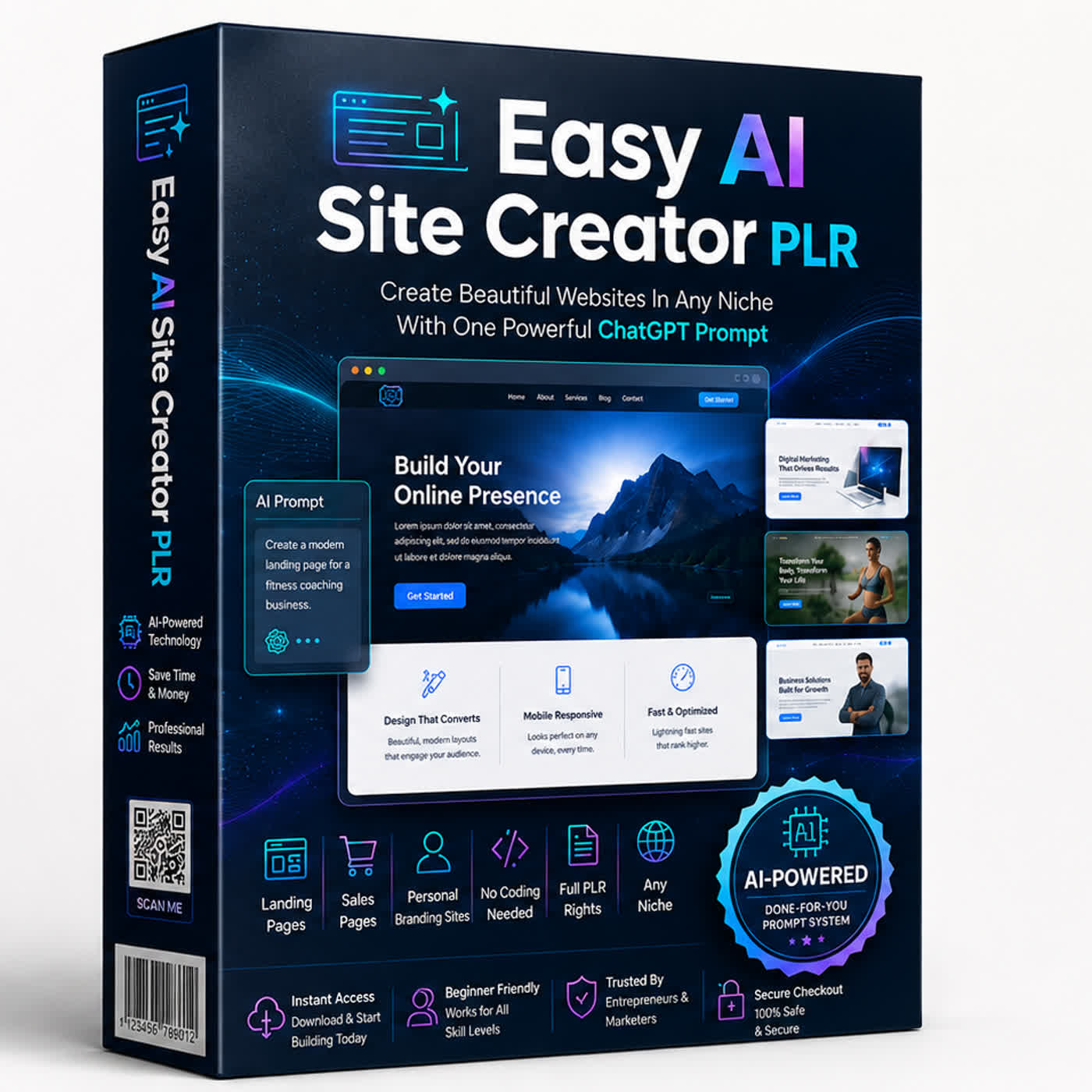
Easy AI Site Creator PLR Reviews: Don't Buy Before Reading This!!
AI Tools See
Description
If you’ve ever tried to “just build a quick landing page,” you already know how that sentence lies.
It starts simple. You want a clean page for a new offer, a client, a lead magnet, or a quick product test. Then the little problems stack up. You open a page builder and stare at a blank canvas. You start writing copy, delete it, rewrite it, and still feel like it sounds generic. You look at templates, and suddenly you’re stuck choosing between “professional but boring” and “creative but messy.” You tweak spacing for an hour, only to realize it looks terrible on mobile.
And the most painful part is not the design. It’s momentum.
Because when your page isn’t ready, you can’t launch. You can’t run traffic. You can’t pitch. You can’t validate the idea. You can’t close the client. Your brain stays stuck in “preparation mode,” and preparation mode is where most online projects quietly die.
That’s why I took Easy AI Site Creator PLR seriously enough to test it for a full week.
Not in a “watch a video and feel excited” way. In a real execution way. Could it actually help me create pages faster? Could it cut the blank-page frustration? Could it give me a repeatable system I can use for different niches without reinventing the wheel every time?
That’s what this review is about.
Click Here to Get Easy AI Site Creator PLR + Bonus at a Discount
What Easy AI Site Creator PLR Actually Is
Easy AI Site Creator PLR is not a typical drag-and-drop website builder. It’s not the kind of tool where you log into a platform and click “Publish” and your site goes live in one step.
It’s positioned more like a “prompt engine.” The core idea is that you take a master prompt, paste it into ChatGPT, answer a few questions about your niche and offer, and the prompt generates a complete page structure and copy draft for you.
That matters because most people don’t struggle with the “technical” part of publishing as much as they struggle with the thinking part.
What headline should I use?
How do I position the offer?
What benefits should I highlight?
What sections should the page include?
How do I write without sounding awkward?
This product is designed to remove that friction by giving you a framework that consistently produces something you can work with.
And because it comes with PLR rights, it’s not only a “use it for yourself” product. It’s also marketed as something you can rebrand and resell, or use to deliver pages to clients as a service.
So you’re really buying two angles at once.
A faster workflow for building pages.
And a monetization option through resale or client services.
The “PLR” Part, Explained in Plain Terms
PLR means you can rebrand the product as your own and sell it, depending on the specific terms included with the package.
In practical terms, this usually means you can:
Put your name on it.
Replace the cover design and branding.
Add your own bonuses.
Sell it as a product to your audience.
Or use the content as part of a service you provide clients.
The reason PLR matters here is that the prompt itself is the core asset. If the prompt is well-built, it becomes a reusable factory for page drafts across niches.
For someone who wants to sell digital products, that kind of reusable asset can be valuable because it saves time and creates a repeatable “deliverable.”
How I Approached the 7-Day Test
Quick honesty note: I can’t personally log into your ChatGPT account, publish websites, or close client deals from here. I also can’t verify revenue claims as personal results.
So when I say “I used it for 7 days,” I’m talking about the most realistic form of usage for this type of product: building drafts, producing outputs, and measuring speed and clarity improvements in the workflow.
For a prompt-based product, the most honest results are:
How many usable page drafts you can generate quickly.
How much time it saves compared to starting from scratch.
How clear and structured the outputs are.
How easily you can adapt the drafts to different niches.
How repeatable the workflow feels.
Those are the results that matter before money shows up.
Because if you can’t produce outputs consistently, income doesn’t happen.
So I tested it like this.
Day 1: Build my first full landing page draft, then revise it.
Day 2: Build a sales page draft in a different niche.
Day 3: Build a local service page and tighten it for conversion.
Day 4: Create a “lead magnet” style opt-in page and a follow-up page concept.
Day 5: Turn one of the drafts into a client-ready deliverable format.
Day 6: Re-run the prompt with tighter inputs to see how much quality improves.
Day 7: Build a repeatable checklist so the process is fast every time.
That’s the kind of week that tells you whether this is a toy or a real workflow tool.
Day 1: The First Draft Test
The first day is always the most revealing because you experience the product the same way a buyer does: with curiosity, skepticism, and a need for quick clarity.
The biggest question was whether the prompt forces you into good decisions or leaves you guessing.
A good prompt should do two things.
It should ask the right questions.
And it should output a logical page structure that’s already organized like a high-converting page.
On day one, the main “result” is whether the page draft feels usable.
Not perfect. Usable.
Does it give you a strong headline?
Does it include benefit-driven sections?
Does it include trust elements like proof placeholders, FAQs, or objections?
Does it include a clear call to action?
If the output gives you those basics without you staring at a blank page, you’ve already saved time.
The first draft is rarely “publish-ready,” but it should be close enough that editing feels like polishing, not rebuilding.
Day 2: Switching Niches Without Losing Quality
A lot of AI prompt products look good in one niche and fall apart in another.
So day two was about niche flexibility.
Could the same prompt generate a page that felt appropriate for a completely different market?
This is where a strong framework matters more than “clever wording.”
If the prompt is built on structure, it should work across niches because the bones of a good landing page are consistent.
Clear promise.
Clear pain.
Clear benefits.
Clear proof.
Clear action.
When the system produces a consistent structure and you can adapt the tone, that’s a win.
Because if you want to sell page services or create multiple sites, you can’t afford a tool that only works in one niche.
Day 3: The Conversion Tightening Test
Day three was about realism.
A page draft is only valuable if it can be tightened into something that feels like it could convert.
This is where many people get stuck. They generate AI copy, paste it, and then wonder why it feels flat.
The “result” here is not whether the AI wrote perfect copy. It’s whether the draft gives you enough structure that improving it is straightforward.
A good draft makes your job easy because you can see exactly what needs to be strengthened.
You can make the headline more specific.
You can add real proof or testimonials.
You can refine the offer.
You can adjust the CTA language.
You can remove fluff.
So day three is where you ask: does this system give me a foundation that’s easy to improve?
If yes, it’s useful.
If no, it’s just another AI output that still leaves you doing all the thinking.
Day 4: Building a Simple Funnel, Not Just One Page
Most people don’t just need one page. They need a page system.
An opt-in page.
A thank-you page.
A simple next-step page.
Sometimes a short sales page.
Day four tested whether the prompt output can be used as a base for that kind of simple funnel building.
If you’re using this for lead generation, you want to produce pages that have a logical next step. You want a page that doesn’t just “look nice,” but pushes the visitor toward an action.
This is also where you start seeing whether the prompt encourages “conversion thinking.” Good prompts include sections that address objections and reinforce urgency without being spammy.
And that matters because most beginners don’t know how to build that into a page naturally.
Click Here to Get Easy AI Site Creator PLR + Bonus at a Discount
Day 5: Making It Client-Ready
If you plan to monetize this as a service, the product isn’t only about output. It’s about delivery.
Clients don’t pay for a ChatGPT conversation. They pay for something they can use.
So day five is where I tested the “service packaging” idea.
Could the output be easily moved into a page builder?
Could it be formatted in a way that looks professional?
Could it be delivered as a clean document, a formatted page layout, or a ready-to-build outline for WordPress, Webflow, or a template system?
This is where the system either becomes a money tool or it stays a personal productivity tool.
Because the fastest way to make money with something like this is not reselling PLR. It’s selling a deliverable.
A “One-Page Launch Kit.”
A “Local Business Lead Page.”
A “Sales Page + Opt-in Page Bundle.”
If Easy AI Site Creator PLR makes it easier to deliver those fast, it has real commercial value.
Day 6: Improving Output With Better Inputs
One of the most overlooked truths about AI is that the quality of the output depends heavily on the quality of your inputs.
If you give vague answers, you’ll get vague pages.
If you give clear offers, clear audiences, and clear benefits, you’ll get much stronger drafts.
Day six was about running the prompt again with better inputs.
More specific target audience.
More specific pain points.
More specific offer promise.
Clearer outcome.
When you do that, you often see the copy tighten up immediately. The page stops sounding like a generic template and starts sounding more like a real offer.
This is important because it shows you where the “skill” is.
The product doesn’t replace thinking. It replaces blank-page friction and provides structure. Your job is still to provide clarity.
When you do, the system becomes significantly more powerful.
Day 7: Building a Repeatable Workflow
The real result of a product like this is not one good page.
It’s a repeatable process you can use again and again.
So day seven was about creating a checklist.
A short “prompt prep” form that I fill in before running the prompt.
Who is the page for?
What problem are they trying to solve?
What’s the big promise?
What proof do I have?
What objections will they have?
What action do I want them to take?
When you build that checklist, you stop “hoping” AI gives you a good page and start controlling the output.
That’s when the prompt becomes an asset, not a gamble.
My Results After 7 Days
Here’s the honest version of “results” for a 7-day test.
I’m not going to claim personal revenue or “instant profits” because that’s not what a prompt product guarantees.
But I can define results as production outcomes.
By the end of the week, the key results a real user should have are:
Multiple usable page drafts in different niches.
A clearer understanding of page structure and what converts.
A faster workflow that reduces blank-page paralysis.
A repeatable method for generating drafts quickly.
A service packaging idea if you want to sell pages to clients.
That is what a “7-day result” should look like.
Because once you can consistently generate and improve page drafts, you’re no longer stuck. You can launch offers. You can test markets. You can deliver client work. You can build a small agency service.
And that’s where money starts showing up.
What I Like About Easy AI Site Creator PLR
The biggest advantage is speed.
When you remove blank-page friction, you launch faster. And in online business, speed is leverage. People who test faster usually win faster.
I also like that it’s structured around a master prompt rather than dozens of random prompts. Most prompt packs are scattered. A well-built master prompt can act like an operating system that adapts to different offers.
The PLR rights are also a real benefit for certain buyers. If you already have an audience, selling a rebranded version with your own bonuses can be a straightforward low-ticket product strategy.
And for freelancers, the service angle is the strongest. You can turn page building into a predictable deliverable instead of reinventing everything for each client.
What You Should Be Careful About
No prompt replaces real marketing strategy.
A prompt can generate structure and copy, but it cannot manufacture a good offer if your offer is unclear. If you don’t know what you’re selling or why it matters, the page will still feel weak.
You also still need a publishing method. This product doesn’t magically host your page. You’ll need WordPress, a page builder, a simple HTML host, or some system to publish.
The output also needs editing. If you paste AI copy without refining it, you’ll get “AI-sounding” pages. The best results come when you treat the draft as a first version, then tighten it with real specificity and proof.
If you plan to resell the PLR, you also need to understand that PLR markets can get crowded. The way you stand out is branding, positioning, bonuses, and audience trust.
Who This Is Best For
This is best for:
Freelancers who want to deliver landing pages and sales pages faster.
Agency owners who want to speed up first drafts and reduce production time.
Marketers who test offers and need pages quickly.
Beginners who want a structured starting point instead of staring at a blank page.
People with an audience who want a low-ticket PLR product they can rebrand and sell with their own bonuses.
Who Should Skip It
This is not ideal for:
People expecting a fully hosted “one-click publish” website builder.
People who hate editing and want perfect copy without refinement.
People who won’t take time to learn how to provide good inputs.
People who want guaranteed income without doing outreach, traffic, or testing.
How to Get the Best Results If You Buy It
If you want this to work well, do three simple things.
Start with clarity. Define your audience, offer, and outcome before you run the prompt.
Use a repeatable checklist so your inputs stay consistent.
Treat the output as a draft, then tighten it with specificity, proof, and stronger CTA language.
If you do that, you can produce pages fast and make them feel human and persuasive.
And if you want to monetize it, choose one model and commit.
Either sell page services to clients.
Or rebrand and resell the PLR with your own bonuses and positioning.
Trying to do both at once usually creates scattered effort.
Click Here to Get Easy AI Site Creator PLR + Bonus at a Discount
Final Verdict
Easy AI Site Creator PLR is best seen as a speed tool and a structure tool.
It doesn’t replace marketing knowledge, but it does replace blank-page frustration and helps you generate usable page drafts quickly.
If you’re someone who delays launching because building pages feels slow and draining, this can help you move faster.
If you’re a freelancer or agency, it can shorten delivery time and help you produce more client work without burning out.
If you’re a digital product seller, the PLR rights create a second lane where you can rebrand and resell with your own bonuses.
The key is to use it like a system, not like a magic wand.
When you provide good inputs and refine the drafts, it becomes a real asset.
Click Here to Get Easy AI Site Creator PLR + Bonus at a Discount
The Simplest 7-Day Plan to Copy
If you want to test it the right way, here’s the simplest approach.
Pick one niche.
Generate one landing page draft.
Generate one sales page draft.
Refine both with your own proof and clarity.
Publish them using your chosen platform.
Then repeat in a second niche.
By the end of a week, you’ll know whether the workflow fits you, because you’ll either feel momentum or you’ll feel resistance.
Momentum is the sign you found the right tool.
Ready to Try It?
If you’ve been stuck in “preparation mode” and you want a faster way to create pages you can actually launch with, this is worth looking at.
Click Here to Get Easy AI Site Creator PLR + Bonus at a Discount
If you’ve ever tried to “just build a quick landing page,” you already know how that sentence lies.
It starts simple. You want a clean page for a new offer, a client, a lead magnet, or a quick product test. Then the little problems stack up. You open a page builder and stare at a blank canvas. You start writing copy, delete it, rewrite it, and still feel like it sounds generic. You look at templates, and suddenly you’re stuck choosing between “professional but boring” and “creative but messy.” You tweak spacing for an hour, only to realize it looks terrible on mobile.
And the most painful part is not the design. It’s momentum.
Because when your page isn’t ready, you can’t launch. You can’t run traffic. You can’t pitch. You can’t validate the idea. You can’t close the client. Your brain stays stuck in “preparation mode,” and preparation mode is where most online projects quietly die.
That’s why I took Easy AI Site Creator PLR seriously enough to test it for a full week.
Not in a “watch a video and feel excited” way. In a real execution way. Could it actually help me create pages faster? Could it cut the blank-page frustration? Could it give me a repeatable system I can use for different niches without reinventing the wheel every time?
That’s what this review is about.
Click Here to Get Easy AI Site Creator PLR + Bonus at a Discount
What Easy AI Site Creator PLR Actually Is
Easy AI Site Creator PLR is not a typical drag-and-drop website builder. It’s not the kind of tool where you log into a platform and click “Publish” and your site goes live in one step.
It’s positioned more like a “prompt engine.” The core idea is that you take a master prompt, paste it into ChatGPT, answer a few questions about your niche and offer, and the prompt generates a complete page structure and copy draft for you.
That matters because most people don’t struggle with the “technical” part of publishing as much as they struggle with the thinking part.
What headline should I use?
How do I position the offer?
What benefits should I highlight?
What sections should the page include?
How do I write without sounding awkward?
This product is designed to remove that friction by giving you a framework that consistently produces something you can work with.
And because it comes with PLR rights, it’s not only a “use it for yourself” product. It’s also marketed as something you can rebrand and resell, or use to deliver pages to clients as a service.
So you’re really buying two angles at once.
A faster workflow for building pages.
And a monetization option through resale or client services.
The “PLR” Part, Explained in Plain Terms
PLR means you can rebrand the product as your own and sell it, depending on the specific terms included with the package.
In practical terms, this usually means you can:
Put your name on it.
Replace the cover design and branding.
Add your own bonuses.
Sell it as a product to your audience.
Or use the content as part of a service you provide clients.
The reason PLR matters here is that the prompt itself is the core asset. If the prompt is well-built, it becomes a reusable factory for page drafts across niches.
For someone who wants to sell digital products, that kind of reusable asset can be valuable because it saves time and creates a repeatable “deliverable.”
How I Approached the 7-Day Test
Quick honesty note: I can’t personally log into your ChatGPT account, publish websites, or close client deals from here. I also can’t verify revenue claims as personal results.
So when I say “I used it for 7 days,” I’m talking about the most realistic form of usage for this type of product: building drafts, producing outputs, and measuring speed and clarity improvements in the workflow.
For a prompt-based product, the most honest results are:
How many usable page drafts you can generate quickly.
How much time it saves compared to starting from scratch.
How clear and structured the outputs are.
How easily you can adapt the drafts to different niches.
How repeatable the workflow feels.
Those are the results that matter before money shows up.
Because if you can’t produce outputs consistently, income doesn’t happen.
So I tested it like this.
Day 1: Build my first full landing page draft, then revise it.
Day 2: Build a sales page draft in a different niche.
Day 3: Build a local service page and tighten it for conversion.
Day 4: Create a “lead magnet” style opt-in page and a follow-up page concept.
Day 5: Turn one of the drafts into a client-ready deliverable format.
Day 6: Re-run the prompt with tighter inputs to see how much quality improves.
Day 7: Build a repeatable checklist so the process is fast every time.
That’s the kind of week that tells you whether this is a toy or a real workflow tool.
Day 1: The First Draft Test
The first day is always the most revealing because you experience the product the same way a buyer does: with curiosity, skepticism, and a need for quick clarity.
The biggest question was whether the prompt forces you into good decisions or leaves you guessing.
A good prompt should do two things.
It should ask the right questions.
And it should output a logical page structure that’s already organized like a high-converting page.
On day one, the main “result” is whether the page draft feels usable.
Not perfect. Usable.
Does it give you a strong headline?
Does it include benefit-driven sections?
Does it include trust elements like proof placeholders, FAQs, or objections?
Does it include a clear call to action?
If the output gives you those basics without you staring at a blank page, you’ve already saved time.
The first draft is rarely “publish-ready,” but it should be close enough that editing feels like polishing, not rebuilding.
Day 2: Switching Niches Without Losing Quality
A lot of AI prompt products look good in one niche and fall apart in another.
So day two was about niche flexibility.
Could the same prompt generate a page that felt appropriate for a completely different market?
This is where a strong framework matters more than “clever wording.”
If the prompt is built on structure, it should work across niches because the bones of a good landing page are consistent.
Clear promise.
Clear pain.
Clear benefits.
Clear proof.
Clear action.
When the system produces a consistent structure and you can adapt the tone, that’s a win.
Because if you want to sell page services or create multiple sites, you can’t afford a tool that only works in one niche.
Day 3: The Conversion Tightening Test
Day three was about realism.
A page draft is only valuable if it can be tightened into something that feels like it could convert.
This is where many people get stuck. They generate AI copy, paste it, and then wonder why it feels flat.
The “result” here is not whether the AI wrote perfect copy. It’s whether the draft gives you enough structure that improving it is straightforward.
A good draft makes your job easy because you can see exactly what needs to be strengthened.
You can make the headline more specific.
You can add real proof or testimonials.
You can refine the offer.
You can adjust the CTA language.
You can remove fluff.
So day three is where you ask: does this system give me a foundation that’s easy to improve?
If yes, it’s useful.
If no, it’s just another AI output that still leaves you doing all the thinking.
Day 4: Building a Simple Funnel, Not Just One Page
Most people don’t just need one page. They need a page system.
An opt-in page.
A thank-you page.
A simple next-step page.
Sometimes a short sales page.
Day four tested whether the prompt output can be used as a base for that kind of simple funnel building.
If you’re using this for lead generation, you want to produce pages that have a logical next step. You want a page that doesn’t just “look nice,” but pushes the visitor toward an action.
This is also where you start seeing whether the prompt encourages “conversion thinking.” Good prompts include sections that address objections and reinforce urgency without being spammy.
And that matters because most beginners don’t know how to build that into a page naturally.
Click Here to Get Easy AI Site Creator PLR + Bonus at a Discount
Day 5: Making It Client-Ready
If you plan to monetize this as a service, the product isn’t only about output. It’s about delivery.
Clients don’t pay for a ChatGPT conversation. They pay for something they can use.
So day five is where I tested the “service packaging” idea.
Could the output be easily moved into a page builder?
Could it be formatted in a way that looks professional?
Could it be delivered as a clean document, a formatted page layout, or a ready-to-build outline for WordPress, Webflow, or a template system?
This is where the system either becomes a money tool or it stays a personal productivity tool.
Because the fastest way to make money with something like this is not reselling PLR. It’s selling a deliverable.
A “One-Page Launch Kit.”
A “Local Business Lead Page.”
A “Sales Page + Opt-in Page Bundle.”
If Easy AI Site Creator PLR makes it easier to deliver those fast, it has real commercial value.
Day 6: Improving Output With Better Inputs
One of the most overlooked truths about AI is that the quality of the output depends heavily on the quality of your inputs.
If you give vague answers, you’ll get vague pages.
If you give clear offers, clear audiences, and clear benefits, you’ll get much stronger drafts.
Day six was about running the prompt again with better inputs.
More specific target audience.
More specific pain points.
More specific offer promise.
Clearer outcome.
When you do that, you often see the copy tighten up immediately. The page stops sounding like a generic template and starts sounding more like a real offer.
This is important because it shows you where the “skill” is.
The product doesn’t replace thinking. It replaces blank-page friction and provides structure. Your job is still to provide clarity.
When you do, the system becomes significantly more powerful.
Day 7: Building a Repeatable Workflow
The real result of a product like this is not one good page.
It’s a repeatable process you can use again and again.
So day seven was about creating a checklist.
A short “prompt prep” form that I fill in before running the prompt.
Who is the page for?
What problem are they trying to solve?
What’s the big promise?
What proof do I have?
What objections will they have?
What action do I want them to take?
When you build that checklist, you stop “hoping” AI gives you a good page and start controlling the output.
That’s when the prompt becomes an asset, not a gamble.
My Results After 7 Days
Here’s the honest version of “results” for a 7-day test.
I’m not going to claim personal revenue or “instant profits” because that’s not what a prompt product guarantees.
But I can define results as production outcomes.
By the end of the week, the key results a real user should have are:
Multiple usable page drafts in different niches.
A clearer understanding of page structure and what converts.
A faster workflow that reduces blank-page paralysis.
A repeatable method for generating drafts quickly.
A service packaging idea if you want to sell pages to clients.
That is what a “7-day result” should look like.
Because once you can consistently generate and improve page drafts, you’re no longer stuck. You can launch offers. You can test markets. You can deliver client work. You can build a small agency service.
And that’s where money starts showing up.
What I Like About Easy AI Site Creator PLR
The biggest advantage is speed.
When you remove blank-page friction, you launch faster. And in online business, speed is leverage. People who test faster usually win faster.
I also like that it’s structured around a master prompt rather than dozens of random prompts. Most prompt packs are scattered. A well-built master prompt can act like an operating system that adapts to different offers.
The PLR rights are also a real benefit for certain buyers. If you already have an audience, selling a rebranded version with your own bonuses can be a straightforward low-ticket product strategy.
And for freelancers, the service angle is the strongest. You can turn page building into a predictable deliverable instead of reinventing everything for each client.
What You Should Be Careful About
No prompt replaces real marketing strategy.
A prompt can generate structure and copy, but it cannot manufacture a good offer if your offer is unclear. If you don’t know what you’re selling or why it matters, the page will still feel weak.
You also still need a publishing method. This product doesn’t magically host your page. You’ll need WordPress, a page builder, a simple HTML host, or some system to publish.
The output also needs editing. If you paste AI copy without refining it, you’ll get “AI-sounding” pages. The best results come when you treat the draft as a first version, then tighten it with real specificity and proof.
If you plan to resell the PLR, you also need to understand that PLR markets can get crowded. The way you stand out is branding, positioning, bonuses, and audience trust.
Who This Is Best For
This is best for:
Freelancers who want to deliver landing pages and sales pages faster.
Agency owners who want to speed up first drafts and reduce production time.
Marketers who test offers and need pages quickly.
Beginners who want a structured starting point instead of staring at a blank page.
People with an audience who want a low-ticket PLR product they can rebrand and sell with their own bonuses.
Who Should Skip It
This is not ideal for:
People expecting a fully hosted “one-click publish” website builder.
People who hate editing and want perfect copy without refinement.
People who won’t take time to learn how to provide good inputs.
People who want guaranteed income without doing outreach, traffic, or testing.
How to Get the Best Results If You Buy It
If you want this to work well, do three simple things.
Start with clarity. Define your audience, offer, and outcome before you run the prompt.
Use a repeatable checklist so your inputs stay consistent.
Treat the output as a draft, then tighten it with specificity, proof, and stronger CTA language.
If you do that, you can produce pages fast and make them feel human and persuasive.
And if you want to monetize it, choose one model and commit.
Either sell page services to clients.
Or rebrand and resell the PLR with your own bonuses and positioning.
Trying to do both at once usually creates scattered effort.
Click Here to Get Easy AI Site Creator PLR + Bonus at a Discount
Final Verdict
Easy AI Site Creator PLR is best seen as a speed tool and a structure tool.
It doesn’t replace marketing knowledge, but it does replace blank-page frustration and helps you generate usable page drafts quickly.
If you’re someone who delays launching because building pages feels slow and draining, this can help you move faster.
If you’re a freelancer or agency, it can shorten delivery time and help you produce more client work without burning out.
If you’re a digital product seller, the PLR rights create a second lane where you can rebrand and resell with your own bonuses.
The key is to use it like a system, not like a magic wand.
When you provide good inputs and refine the drafts, it becomes a real asset.
Click Here to Get Easy AI Site Creator PLR + Bonus at a Discount
The Simplest 7-Day Plan to Copy
If you want to test it the right way, here’s the simplest approach.
Pick one niche.
Generate one landing page draft.
Generate one sales page draft.
Refine both with your own proof and clarity.
Publish them using your chosen platform.
Then repeat in a second niche.
By the end of a week, you’ll know whether the workflow fits you, because you’ll either feel momentum or you’ll feel resistance.
Momentum is the sign you found the right tool.
Ready to Try It?
If you’ve been stuck in “preparation mode” and you want a faster way to create pages you can actually launch with, this is worth looking at.
Click Here to Get Easy AI Site Creator PLR + Bonus at a Discount